

Table of Contents
- The Argentine Tango Experience
- Optimal Fit and Comfort
- Choice of Dance Sole
- Different Types of Tango Dance Styles
- Maintenance and Maximum Lifespan
- Appearing Stylishly at the Milonga
- Frequently Asked Questions
You are standing in the middle of a busy milonga, you prepare for an elegant turn, but you notice that you lose grip or that your axis doesn't feel quite stable enough. Good tango shoes for men form the technical foundation of your dance; they distinguish themselves by a smooth sole of leather or suede for controlled rotations and a specific heel height that optimally shifts your weight to the ball of the foot. In my classes, I often see men starting in their daily office shoes, but those simply do not offer the flexibility and lateral support that Argentine tango requires.
After thousands of hours on the floor, I know that the right shoe makes the difference between uncertain shuffling and a powerful, stable connection with your partner. It's about that subtle balance between aesthetics and functional precision. Whether you choose a classic calfskin model or a modern suede variant, the stability that a specialized dance shoe provides to your heel and instep is irreplaceable. I am happy to help you make the right choice, so that your feet are no longer an obstacle, but instead become your greatest asset during every dance night.
The Argentine Tango Experience
Anyone stepping into a milonga for the first time immediately notices that Argentine tango is more than just a series of steps; it is a physical conversation between two people. In practice, I often see beginners focusing blindly on complicated figures, while the real experience lies in the 'caminada' – the walk. A good walk requires you to transfer your weight completely to the ball of your foot, without losing your axis. This requires a specific type of stability that you rarely need in daily life. What I often see with dancers who are just starting out is that they try to dance in regular men's shoes with a thick rubber sole. This is a common mistake. Rubber 'bites' into the floor, which is disastrous for your knees during a pivot (turning on the ball of the foot). In a crowded room where you have to navigate between other couples, you need footwear that allows you to turn on a dime without friction. The right tango shoes have a sole of leather or suede that offers just enough slip to turn, but maintains enough grip for a powerful push-off during an acceleration in the music.Technique, connection and the floor
The connection in tango starts at your own feet and runs through your axis to your partner. If your partner, for example, chooses specific tango shoes with a slender heel, her center of gravity and the way she entrusts her weight to you changes. As a leader, you must be able to absorb that subtle shift. In practice, I notice that men who dance in shoes that are too heavy or too wide often lose the feeling for the floor. You want to 'read' the floor through your soles; you need to feel where you stand to guide your partner safely. In Argentine tango, much revolves around 'dissociation' – moving your upper and lower body independently of each other. To perform this technically well, you need a stable base. Here are a few practical points of attention for the dance floor:- Keep your weight always slightly forward, toward the ball of the foot, but ensure your heel can still 'kiss' the floor for stability.
- Ensure your shoes fit tightly around the instep; every millimeter of play inside your shoe translates into an imprecise, wobbling movement in your dance.
- Pay attention to the heel height; many specific men's shoes for tango have a slightly raised heel (often the 'French heel' of 2.5 to 4 cm) to help place your weight forward naturally.
Optimal Fit and Comfort
In practice, I often see men buying their dance shoes a size too large. They are used to the space in a sneaker or a casual work shoe, but in Argentine tango, that extra space is your biggest enemy. A common mistake is ignoring the 'break-in' period. A good leather shoe molds itself to the unique contours of your foot. If a shoe already fits like a comfortable slipper in the store, there is a good chance it will wobble too loosely around your foot after three nights at the milonga.
What I often advise is to look for a fit that fully supports and encloses the arch. When you shift your weight forward for a pivot, your heel should under no circumstances slip out of the shoe. This slipping not only causes painful blisters, but it also interrupts direct communication with your partner. The right tango shoes should feel like a second skin, where the sole reacts directly to every subtle weight shift you make.
The anatomy of a good dance shoe
A crucial aspect of comfort that is often overlooked is the cushioning under the ball of the foot. During a long milonga, you are constantly on your forefeet to control your axis. Without proper padding, you will inevitably suffer from burning metatarsals. When fitting, pay specific attention to the following technical details:
- The heel counter must be sturdy and support the Achilles tendon without irritating it during foot extension.
- The toe of the shoe must offer enough space so your toes do not overlap, but it must be narrow enough to prevent lateral sliding within the shoe.
- The lace closure must be high enough on the instep to keep the foot firmly in place without cutting off circulation during intensive movements.
Contrary to what many beginners think, the stiffness of the sole is of decisive importance for comfort. A sole that is too stiff causes unnecessary strain on the knee joints because you have to force rotation from your joint instead of gliding smoothly across the floor. While men often focus on a stable, wide heel, you see that when choosing tango shoes for women, the balance between flexibility and heel height is even more critical to guarantee stability.
Material choice and the influence on your dance style
Real leather is the most commonly used material in Argentine tango, and for good reason. Leather breathes and has the unique ability to stretch in the places where your foot needs it. I regularly see students choosing cheaper synthetic materials, but they often regret that after a few intensive lessons. Synthetic material does not give, leading to hard pressure points at the little toe or the instep that never go away.
Also, consider that the thickness of the sole influences your 'grounding'. A thinner sole gives more feedback from the floor, which is essential for feeling the texture of the dance floor and performing complex decorations (boleos or ganchos). For dancers with sensitive feet, a slightly thicker sole with extra shock absorption is a better choice to prevent long-term injuries. Ultimately, it's about being on the floor with the same precision at the end of a four-song tanda as at the beginning of the evening.
Choice of Dance Sole
In practice, I see that the sole of a shoe is often the most underestimated part, while it is actually the only point of contact between you and the dance floor. In Argentine tango, this contact is sacred. A common mistake I see with beginning dancers is that they choose a shoe with too much tread or grip, such as a standard men's shoe with a rubber sole. In a dance where the 'pivot' (turning on the ball of the foot) is central, a stiff sole can be disastrous for your knee ligaments and ankles. The right sole should allow you to turn effortlessly during an ocho or giro, without losing control during a powerful step forward.Suede (Chrome Leather): The All-rounder
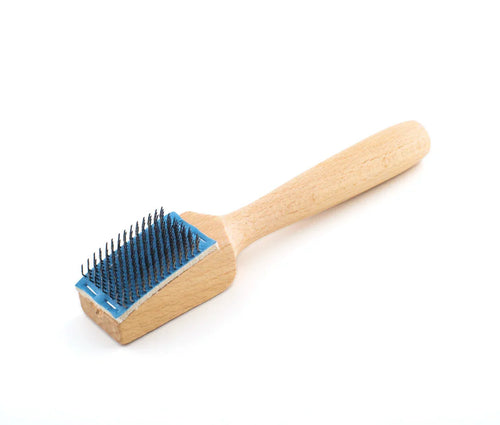
What I often advise dancers who regularly visit different milongas is a chrome leather sole, also known as suede. This material is the standard for most high-quality men's tango shoes because it effortlessly adapts to the condition of the floor. In practice, this works as follows:- On a slippery floor, you use a special steel shoe brush to roughen the fibers of the suede, giving you more grip for powerful push-offs.
- On a stiff floor, you let the sole 'clog up' through dust and natural use, making the sole smoother and easier to pivot.
- It offers direct feedback from the floor, which is essential for your balance and feeling the weight transfer of your partner.
Smooth Leather: For the Experienced Dancer
In addition to suede, you see many soles of hard, smooth leather in the world of Argentine tango. This is a choice I often see with advanced dancers or professionals looking for maximum speed. Smooth leather offers almost no resistance. This is excellent for fast footwork and endless turns, but it requires a strong core and excellent technique not to slip away during a simple step. Just as with the collection of tango shoes for women, where balancing on a heel is challenging enough, a leather sole for men requires a very conscious placement of weight on the metatarsals (the midfoot bones). In practice, I see that leather soles are also more frequently used at outdoor locations or on floors not specifically made for dancing. Suede would be destroyed immediately on a rough stone surface or a terrace, while leather can handle it fine. A disadvantage, however, is the cushioning; leather is harder and gives less than suede. If you notice that your joints start to hurt after a long night of dancing, switching to specific tango shoes with a suede sole and a slightly softer insole can make a big difference for your anatomical load. Regardless of your final choice, remember that your sole is your instrument. A sole that does not match the floor of the milonga where you are at that moment forces you to compensate for your technique, which often leads to a cramped posture in your upper body and a loss of connection with your partner. Therefore, invest in a sole that supports your way of moving, rather than working against it.Different Types of Tango Dance Styles
Many beginning dancers think that tango is one fixed set of steps, but in practice, it is a wide spectrum of styles, each placing its own technical demands on your body and footwear. What I often see on the dance floor is that men struggle with their balance because they don't realize that the dynamics of a Milonga are totally different from those of a traditional Argentine tango. Understanding these differences is the first step toward more self-confidence during the milonga (the dance evening itself).
Argentine Tango (Tango de Salón)
Argentine tango is the basis most dancers start with. Here, everything revolves around the 'abrazo' (the embrace) and the connection with your partner. A common mistake I see with students is lifting the feet too high. In Argentine tango, you want to glide over the floor, almost as if you are 'polishing' the floor with your feet. This requires a specific technique where your weight constantly rests forward on the ball of your foot.
To perform this fluid movement and the associated pivots (turns on the ball of the foot) well, the right tango shoes for men are essential. If your sole has too much grip, your ankles and knees block during a turn, which can cause injuries in the long term. A suede or smooth leather sole helps you to smoothly pass that rotation from the hips to the floor without your joints taking the impact.
Milonga and Tango Waltz
In addition to the standard tango, you also encounter the Milonga and the Tango Waltz on the dance floor. The Milonga is faster, more cheerful, and more rhythmic. The steps are shorter, and you often use the 'traspié', a kind of stumbling step where you change weight very quickly. In practice, I see that men often lose their stability here. Because the tempo is higher, your shoe must fit your foot like a second skin; every millimeter of play in your shoe causes a delay in your reaction time.
The Tango Waltz, on the other hand, is fluid and circular, based on the three-quarter time signature. Here, you make much larger turning movements. For your partner, this is also technically challenging; she must be able to trust her axis while turning. Therefore, it is important that she also invests in quality tango shoes for women that have a sturdy heel connection. A wobbly heel in a Waltz makes it almost impossible for the man to lead the lady well in her turns.
If you look at the technical execution of these styles, there are a few concrete points to look out for:
- Weight distribution: In Argentine tango, your weight is more forward than in most other dances. Your shoe must be able to absorb this pressure on the metatarsals (midfoot bones) without collapsing.
- The Pivot: Almost every movement in tango ends or begins with a turn. The sole of your shoe must offer exactly the right balance between glide and grip.
- Floor contact: Unlike ballroom, where the heel often hits the floor first, in tango you land more often on the whole foot or the ball of the foot. A flexible sole is a major advantage here.
What I often advise dancers who are serious about their technique is to look at the anatomy of their own foot. Do you have a high instep or flat feet? This determines how much support you need in the arch of the shoe. In practice, I see that men who switch from regular sneakers to specialized dance shoes immediately notice an improvement in their axis and their ability to lead the partner stably through the space.
Maintenance and Maximum Lifespan
You have finally found that pair of shoes with which you effortlessly make your pivots and find that perfect balance during a complex sacada. It would be a shame if that investment is already worn out after a few months of intensive dancing at the milonga. What I often see with dancers who are just starting with Argentine tango is that they treat their dance shoes like regular sneakers. But a good dance shoe is a technical instrument that needs specific maintenance to maintain its properties.
The sole: the most important point of contact
A common mistake is ignoring the condition of the sole. Most high-quality tango shoes for men are equipped with a sole of suede or chrome leather. In practice, I see that these soles 'clog up' with a mixture of dust, floor wax, and skin oils after a few nights on a wooden floor. The sole then becomes mirror-smooth or unpredictably sticky, which is disastrous for your knees because you can no longer turn smoothly.
- Use a special steel sole brush to roughen the suede after every three to four dance nights.
- Always brush from the center toward the sides to keep the leather's structure open.
- If you accidentally walk through something wet, let the sole air dry and only brush it once it is completely dry.
Moisture control and rest time
Tango is a physical sport, and your feet produce heat and moisture. A crucial lesson I always give my students: give your shoes rest. The leather and the insole need at least 24 hours to dry completely and recover their shape. If you dance every day, it is essential to alternate between two pairs of shoes. Although the construction and load are different, exactly the same principle applies to tango shoes for women: moisture is the biggest enemy of fit.
In practice, using cedar shoe trees works best. Cedar wood not only extracts moisture from the leather but also neutralizes odors and ensures that the toe of the shoe does not curl upwards. What I often see happening with dancers who throw their shoes loosely in their bag is that the leather wrinkles at the instep, which can eventually lead to cracks in the material.
Protection during transport
Never wear your tango shoes outside on the street. The soles are not made for asphalt or concrete; one walk to the car can irreparably damage the soft sole with small stones penetrating the leather. Only change your shoes at the entrance of the dance hall. Always use the included fabric bags for this. This not only prevents your shoes from being damaged by friction in your bag but also protects the leather from drying out due to direct contact with the outside air.
For the upper part made of smooth leather, I recommend using a small amount of colorless shoe cream monthly. Avoid cheap liquid polishes; these seal the pores of the leather, meaning the shoe can no longer 'breathe'. By consistently performing these small actions, you ensure that your shoes not only last longer but also continue to offer that necessary stability and flexibility you need for a perfect tanda.
Appearing Stylishly at the Milonga
When you step into an authentic milonga for the first time, you immediately notice that the atmosphere is different from an average dance school. The lighting is dimmed, the music of the great orchestras from the '40s fills the room, and there is an unwritten code of elegance in the air. What I often see with men just starting Argentine tango is that they underestimate the impact of their shoe choice on their appearance. In tango, your footwork is your business card. While you wait for a 'cabeceo' (the traditional invitation with the eyes), your posture and your footwear are often the first thing a potential dance partner notices.
A common mistake is wearing shoes that are too coarse or too informal. In practice, a heavy sole only works against you. A good set of tango shoes for men should not only visually match trousers or a nicely tailored suit but also support the refinement of the dance. Tango is about the 'caminada' – the walk. If your shoes are too bulky, you lose contact with the floor and your walk looks stiff instead of fluid and cat-like.
Balance between Aesthetics and Technique
Style at the milonga goes further than just a nice color or shiny leather. It's about how the shoe accentuates your movement. A quality tango shoe often has a slightly higher heel than a normal men's shoe, usually between 2.5 and 4 centimeters. This small difference in anatomy ensures that your weight is shifted slightly more to the ball of your foot. This is essential for the connection with your partner; it allows you to react faster to each other's axis. When you dance together with a partner wearing elegant tango shoes for women, you want your stability to give her the freedom to perform her decorations (adornos) without you wobbling.
In practice, I see that men who choose a two-tone shoe (such as the classic black-and-white 'spectator' style) often radiate more self-confidence in their footwork. It forces you to dance more precisely because every movement is visible. However, if you prefer to stay somewhat in the background while you refine your technique, a classic black suede or matte leather model is a safe and always stylish choice.
Practical tips for the Dance Floor
In addition to appearance, the functionality of your sole determines how stylishly you actually move across the floor. A milonga floor can vary from rough concrete to mirror-smooth parquet. Here are a few things I always look for when advising dancers:
- The sole choice: Leather soles are the standard for the milonga because they allow you to turn (pivot) without straining your knees. Suede soles give slightly more grip, which is nice on a slippery floor, but they require more maintenance with a steel brush.
- Fit and enclosure: A foot that slides inside a shoe causes uncertain steps. Ensure the heel is firmly enclosed so that your foot and shoe feel as one unit during a fast traspié in the milonga rhythm.
- Maintenance: Nothing detracts from your appearance as quickly as dusty or damaged shoes. Polish your leather and brush your suede regularly; it shows respect for the tradition and your dance partners.
Ultimately, style at the milonga is an extension of your dance. When your shoes fit well and match the etiquette of the evening, you no longer have to think about your feet. That is the moment when technique fades into the background and you can truly start enjoying the embrace and the music. Remember that you are not only dancing for yourself, but also for the aesthetics of the entire dance floor.
Frequently Asked Questions
Which shoes for ballroom dancing?
For ballroom dancing, shoes with a suede sole are the standard because they offer the right balance between grip and glide on wooden floors. For Argentine tango, men often specifically choose leather or suede soles to turn smoothly. A good dance shoe is lightweight, flexible, and provides sufficient arch support, which is essential for complex steps and comfort.
What are the different types of Tango?
There are mainly two categories: Ballroom Tango and Argentine Tango. Ballroom Tango is a structured competitive dance with fixed patterns and a stiff posture. Argentine Tango, which you dance at a milonga, is improvisation-oriented and revolves around the connection between partners. Within the Argentine style, variants such as Tango de Salón and Tango Nuevo exist, each requiring specific techniques and stable tango shoes.
How long do dance shoes last?
The lifespan of dance shoes depends heavily on usage intensity and the quality of the dance floor. On average, they last between six months and two years with regular use. For avid dancers who visit a milonga weekly, the soles will wear out faster. Proper maintenance, such as regularly brushing suede soles and using shoe trees, significantly extends their lifespan.
How should dance shoes fit?
Dance shoes should fit snugly, almost like a second skin, but without painful pinching. There should be little to no space at the toes to prevent sliding in the shoe, which causes blisters and instability. Because leather tango shoes stretch out slightly over time, a tight fit at the time of purchase is ideal. Ensure the heel is always firmly secured for optimal balance.
What is the difference between a leather and suede sole for tango shoes?
Leather soles are smoother and offer less resistance, making them ideal for stiff floors or dancers who like to turn very smoothly. Suede soles offer more controlled grip and feeling with the floor, which is pleasant on slippery surfaces. Most men's tango shoes have a leather sole to make the characteristic turning movements of Argentine tango easier and safer to perform.
Why are special tango shoes for men important?
Special tango shoes offer a unique combination of flexibility and stability that regular shoes lack. They often have a reinforced bridge and a specially balanced heel to shift the dancer's weight slightly forward. This posture is essential for the correct connection in Argentine tango, while the specialized soles allow for effortless turning without straining the knees.
Can you also wear tango shoes outside the milonga?
It is strongly discouraged to wear tango shoes with suede or thin leather soles outside on the street. Rough asphalt, dirt, and moisture damage the delicate soles immediately and negatively affect the grip on the dance floor. Therefore, always only change your shoes upon arrival at the milonga or in the dance studio. This keeps the soles in top condition for the best dance experience and stability.
The beauty of Argentine tango is the deep connection you make with the music and your partner, but that magic always starts at your own foundation. What I especially want to convey is that the right tango shoes are not an unnecessary luxury, but an essential tool for every dancer who is serious about their technique and posture. Remember above all that a good balance between timeless style and technical stability gives you the freedom to turn with precision and move across the floor with complete confidence during an intensive milonga.
When you invest in quality, you invest directly in your own dancing pleasure and the sustainability of your movements. Give yourself that solid foundation and view our men's tango collection for models that combine craftsmanship with a modern design. Are you also looking for the perfect match for your dance partner? Then discover the graceful designs in our women's tango collection. Ultimately, the dance floor is where technique and passion come together. Make sure your shoes do not limit you, but instead invite you to take every step with complete devotion and pride.


